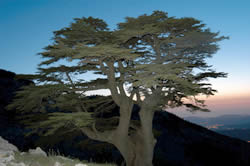
MERRY CHRISTMAS AND HAPPY NEW YEAR 2007
JOYEUX NOËL ET BONNE ANNÉE 2007
-----------------------------
Semaine du 25-31 décembre 2006
-----------------------------
L’icône et l’islam : Pamela Chrabieh
3 décembre 2006, Radio Canada
Un reportage de Jean-Robert Faucher
Merci Robert et à toute l'équipe de Second Regard!
-----------------------------
'Voici la onzième édition des portraits de blogueurs, avec Pamela Chrabieh Badine'.
On peut trouver l'entrevue sur Dailymotion, Cent Papiers et YULBUZZ.
Merci à Philippe et Christian Aubry!
--------------------------------------------------
Lundi 25 décembre 2006:
A tous mes amis-es, collègues, lecteurs et lectrices, je vous souhaite de tout coeur un Joyeux Noël et une Année 2007 empreinte de paix, cette paix que nous recherchons tous-tes d'une manière ou d'une autre, quel que soit l'endroit dans lequel nous nous trouvons. Pour la première fois, nous avons reçu mon mari et moi nos parents pour le réveillon de Noël. En dépit du beau moment que nous avons partagé, je ne vous cache pas la tristesse qui m'envahit ce matin du 25 décembre, comme si je pressens le caractère éphémère du bonheur... Comment être heureux en ces temps de guerres, de conflits, d'exclusions, d'inégalités et d'injustices? Comment avoir le coeur à la fête? L'année 2007 sera-t-elle meilleure que 2006? Y aura-il moins de carnages et plus d'amour et de convivialité? Je l'espère encore... Toutefois, au niveau local Libanais, les facteurs de conflit pèsent plus lourd sur la balance que ceux de la paix: les tensions internes entre le gouvernement et l'opposition se poursuivent, en dépit du semblant de statut quo adopté pour la période des fêtes de Noël, du Nouvel An et d'Al-Adha; la plupart des experts-analystes mettent en garde contre une escalade dès le début de janvier 2007; les journaux israéliens tels Haaretz avaient annoncé il y a quelques jours une offensive israélienne-round 2 au Liban en été 2007 etc. A croire que le Liban est marqué par la colère des dieux... A croire que toute la région Moyen-Orientale l'est... Pourtant, je ne suis pas fataliste. J'ai foi en la responsabilité citoyenne et la responsabilité humaine à faire trembler les montagnes de la violence et de la haine des différences.
En 1980, dans un numéro hors série du journal Le Matin consacré à Sartre, Emmanuel Levinas indiquait un chemin qui échappe à la fois aux embrigadements totalitaires qui ont marqué le 20e siècle - et qui marquent encore ce début du 21e siècle - et au refuge dans une spiritualité éthérée qui se tiendrait à l'écart des combats des êtres humains: "Que la liberté humaine puisse se retrouver à travers tout ce qui s'impose à l'homme, cela venait de Sartre comme un message d'espoir pour toute une génération grandie sous les fatalités par toute l'attente de notre siècle et que l'humanisme de l'éloquence - fût-il glorification des droits de l'homme - n'arrivait plus à convaincre de rien. Une nouvelle philosophie, c'est avant tout la parole rendue à ceux qui l'ont perdue dans la rhétorique où sombrent les grands projets (...). Angoisse pour une liberté d’emblée vouée aux autres, et non pas (..) angoisse pour ma mort, angoisse pour ce qui est le “plus mien”, dans le souci de l’humain que je suis pour mon être même. » (Emmanuel Levinas, Les imprévus de l’histoire, Éditions Fata Morgana, 1994, p. 149-150). En ce sens, l'action humaine est toujours possible, rassemblant tant ceux qui croient au ciel que ceux qui n'y croient pas. Il s'agit d'une philosophie de l'action et de la responsabilité qui refuse à la fois le désespoir et l'utilisation d'échappatoires. Selon Levinas, l'acte, "le premier acte intellectuel, c'est la paix. La paix, en entendant par là ma sollicitation de penser, précède le désir de connaître proprement dit, elle précède la thématisation objective. Il y a raison quand il y a paix, quand il y a rapport pacifique de personne à personne. » (Dans François Poirié, Emmanuel Levinas, qui êtes-vous ? Éditions de la Manufacture, 1987, p. 104) C’est l’acte éthique qui arrête la violence et institue l’autre, non plus comme le mal qu’il faut détruire, mais comme l’interlocuteur avec qui il faut débattre et qui peut évoluer.
-------------------------------------------------
How can the Arab Christians survive?
By Rami G. Khouri
Daily Star staff
Saturday, December 23, 2006
"A commandment of love" was the theme that the Latin patriarch of Jerusalem, Michel Sabbah, stressed when I asked him last week about what Arab Christians should be doing to address the many challenges and threats in the Middle East today. I was especially interested in the role of Arab Christians because their plight is highlighted this Christmas week, even as a delegation of United Kingdom church leaders makes a timely Holy Land pilgrimage.
Christians experience the same pressures and challenges as the majority Muslim population living under Israeli occupation, the assault of Western armies, or the incompetent, autocratic mismanagement of their own Arab political leaders. A strangled Bethlehem, though, is likely to catch the attention of Western citizens and church leaders more than a stressed Alexandria, Aleppo or Casablanca. The four British pilgrims are the archbishop of Canterbury, Rowan Williams; the archbishop of Westminster, Cardinal Cormac Murphy-O'Connor; the moderator of the Free Churches, the Reverend David Coffey; and the primate of the Armenian Church of Great Britain, Bishop Nathan Hovhannisian.
The focal point of their four-day visit is a pilgrimage to the Church of the Nativity in Bethlehem. Their trip and witness will help Christians and other people of good faith around the world better appreciate the impact of the Israeli occupation on all Palestinians, including Christian communities.
Sabbah welcomed the pilgrimage and noted that, "at a time when our communities in the two Holy cities of Jerusalem and Bethlehem are separated by a wall and checkpoints, the visit of the churches' ecumenical delegation is a reminder to us, to the Israelis and the Palestinians, and to the world, that the pilgrims' path of hope and love must remain open."
Hope and love stand in sharp contrast to the Israeli colonization and control policies in and around Bethlehem that have shattered the physical, spiritual and economic integrity of the community, by cutting off the built-up areas from thousands of hectares of agricultural land and water resources. The main culprits are Israel's separation wall to fence in the Palestinians, and an associated system of smaller cement walls, 27 Israeli settlements, and a network of electric fences and apartheid-like "Jewish settlers-only" roads and checkpoints, almost all built on land confiscated from Bethlehem's private owners. The result is a prison-like environment for the people of Bethlehem, 70 percent of whom now live below the poverty line. After Israel's attacks and reoccupation of Bethlehem in 2001 and 2002, some 3,000 Christians emigrated, representing 10 percent of the local Christian population.
Leila Sansour, the Palestinian chief executive of the Open Bethlehem project that works to preserve the city's physical, spiritual, demographic and economic integrity, wrote last week: "A UN report into Christianity in Bethlehem predicts that our community will not survive another two generations. We live from pilgrimages, and our city is closed. We have traditionally stored our wealth in land, and our land behind the wall has been seized. Our lives are intimately bound up, economically and socially, with the Christian community in Jerusalem, yet we are forbidden to enter that city, which lies only 20 minutes away."
When I met with Sabbah in Larnaca, Cyprus, last week, I asked him if he saw a particular role that Arab Christians could and should play. His reply was clear, and challenging: "My vision is that we Christians, whatever are our numbers, are Christians in and for our society, which is a Muslim Arab society. Christians have something specific to give as Christians, because of their belief in Jesus Christ and all the values that Jesus Christ taught us. This is an obligation. Our commandment is a commandment of love, and it is shows the way to build a society. Christian love is about accepting the other or not accepting him. It is about building with the other or refusing to build with him. All the Christian Arabs can bring to Arab society this love as a power of cohesion within the society ... to love themselves and show how to live together with the Muslims who are the majority in these societies."
He went on to say: "There must be a broad project, a social, economic, political project so that people together can see how they can prepare a country and homeland, and enrich every citizen so that he or she feels at home, content and secure, without any fear of the other. All citizens must have the same place and opportunities in terms of their social and political rights."
In replying to a question of mine about whether Arab Christians could play a role as bridges to the West, he answered: "We Christians can be a true bridge through all the churches that are present in the world. All of us together can have an impact. We have an obligation to understand Islam for what it is, therefore we have the obligation even to have alliances with Muslims, in order to build a new type of society, and bring this as a model of coexistence to the West."
Love, indeed, seems worth a try. In that spirit, I say Merry Christmas to all, and early Eid al-Adha and Happy Hanukkah wishes to my Muslim and Jewish brothers and sisters, hoping that all of us together will respond to Michel Sabbah's call for an ideology of love to replace this time of war.
He went on to say: "There must be a broad project, a social, economic, political project so that people together can see how they can prepare a country and homeland, and enrich every citizen so that he or she feels at home, content and secure, without any fear of the other. All citizens must have the same place and opportunities in terms of their social and political rights."
In replying to a question of mine about whether Arab Christians could play a role as bridges to the West, he answered: "We Christians can be a true bridge through all the churches that are present in the world. All of us together can have an impact. We have an obligation to understand Islam for what it is, therefore we have the obligation even to have alliances with Muslims, in order to build a new type of society, and bring this as a model of coexistence to the West."
Love, indeed, seems worth a try. In that spirit, I say Merry Christmas to all, and early Eid al-Adha and Happy Hanukkah wishes to my Muslim and Jewish brothers and sisters, hoping that all of us together will respond to Michel Sabbah's call for an ideology of love to replace this time of war.
---------------------------------------------
"It's more humane to cure your enemies than to kill them."
This quote is an excerpt from my website, organicMD.org, which is dedicated to promoting world peace by improving world health.
Please visit my page called Land of Milk and Honey. It offers unique, practical suggestions for the chronic conflict in the Middle East. I look forward to your comments.
Thank you.
Hugh Mann,
The Patient Doctor hughmann@organicMD.org
~~~~~~~~~~~~~~~~~~
Review of Land of Milk and Honey by Dr. Seth Ward, Director, Institute for Islamic-Judaic Studies at the University of Denver:
"I find your association of milk and honey with love and hate to be fascinating. As far as the Middle East, I don't think anyone has considered diet as a way to solve the problem. Politicians think that looking at political goods is the way to go: security, lands, human and political rights, and so forth. Looking at things like health and cultural considerations is off the scope for politicians and that is absolutely wrong. I don't think the goals of the Roadmap or any other plan can be achieved without attention to the kinds of issues you have indicated."
Review of organicMD.org by Paul Farmer, MD, PhD Professor of Social Medicine, Harvard Medical School:
"Your website is interesting and informative, along with being well-designed and easy to navigate. I think your over-all message is an important one for people to learn: that while pharmaceuticals have a significant role in healthcare, they are not the whole solution. Clean air, pure water, organic food, and the avoidance of toxins and addictions, as you explain, are key to good health. You list many practical, how-to solutions for people; I was particularly impressed by the depth of research that clearly informed your LOVE diet. This site will certainly prove useful to many people seeking to improve their lives and their health, especially patients suffering from chronic conditions that traditional medicine has not effectively addressed."
-------------------------------------------------
NEEDS YOUR SUPPORT
27 decembre 2006
SOLIDA -
The SOLIDA movement (Support of Lebanese Detained Arbitrarily) has for years fought for the principles of Human Rights and the Rule of Law for Lebanon and its people.
We have catalogued the files of hundreds of Lebanese prisoners in Syria and Israel and have lobbied international institutions and governments to address this tragedy as a basis to help the Lebanese people undergo the psychological healing towards a genuine National Reconciliation. After operating for nearly 10 years from France, SOLIDA has moved to Beirut in May 2006. SOLIDA is a registered, independent, non-profit Lebanese organization that is not affiliated with any political party or religious denomination in Lebanon. Its work transcends political and sectarian differences in promoting the international principles of human rights and the rule of law.
27 decembre 2006
SOLIDA -
The SOLIDA movement (Support of Lebanese Detained Arbitrarily) has for years fought for the principles of Human Rights and the Rule of Law for Lebanon and its people.
We have catalogued the files of hundreds of Lebanese prisoners in Syria and Israel and have lobbied international institutions and governments to address this tragedy as a basis to help the Lebanese people undergo the psychological healing towards a genuine National Reconciliation. After operating for nearly 10 years from France, SOLIDA has moved to Beirut in May 2006. SOLIDA is a registered, independent, non-profit Lebanese organization that is not affiliated with any political party or religious denomination in Lebanon. Its work transcends political and sectarian differences in promoting the international principles of human rights and the rule of law.
At present, a small team of 10 volunteers is involved in:
- Monitoring human rights conditions on the ground in Lebanon.
- Supporting twelve victims of arbitrary detention in Lebanon.
- Tracking the missing and detained Lebanese in Syria and Israel.
- Pursuing a platform of National Reconciliation that can only be achieved by recognizing and healing the past, which should begin by accounting for those of us who remain missing.
- Laying the ground for a Rehabilitation Center in Beirut for all victims of torture and arbitrary detention to help them find jobs, re-learn to live with their families and reintegrate society.
This is the most difficult, but important, challenge: To help those among us who suffered the most, physically and psychologically, from the past decades of conflict and pain.
SOLIDA recently received sponsorship from the Euro-Mediterranean Human Rights Network Foundation, for the hiring of a Director who assumes functions this January 2007. Beyond this, the financial burden for the volunteers’ considerable efforts and the assistance we give to former prisoners is assumed by the volunteers themselves. Recently, two local benefactors contributed to replacing the computer equipment that was stolen from our premises this past October 2006.
We need your support.
We are issuing this CALL FOR ASSISTANCE because we believe that you, the Lebanese Diaspora, will support and nurture meaningful work that translates the success stories and accomplishments of Lebanese emigrants into real action in their homeland. We call on people who feel deeply about our work to make their financial contribution in small but regular amounts. To this effect, we have created a Paypal account which you can access online on www.solida.org
Thank you for answering this call and for making your contribution today. We know it resonates with your aspirations for a humane and compassionate Lebanon. Our struggle will never cease until we achieve the objectives of human rights and the rule of law, a true national reconciliation based on Truth and Justice, the uncovering of the fate of each one of the disappeared and missing, the review of all unfair trials, and the reparations owed to each victim of human rights violations.
WE COUNT ON YOU.
GO TO WWW.SOLIDA.ORG AND MAKE YOUR REGULAR CONTRIBUTION TODAY.
Or Contact SOLIDA at:
SOLIDA – Lebanese Center for Human Rights
Mar Youssef Center – 12th FloorDORA – BEIRUT
LEBANON
Tel: (+961) 3 887 108 ou (+961) 70 950 780
Email:solida@solida.org