Showing posts with label War. Show all posts

Thursday, October 29, 2015

Peace Education in Lebanon - The 7th Asian Conference on Education (Kobe-Japan)

Academic Virtual presentation (power point video format) about my pedagogical approach and my research in three Lebanese universities from 2007 till 2014.

The 7th Asian Conference on Education,
Art Center of Kobe, Kobe, Japan
Wednesday, October 21 - Sunday, October 25, 2015
http://iafor.org/conferences/ace2015/

This virtual presentation will also be soon published here:
https://www.youtube.com/user/AsianCon...

Conference Programme - View on issuu via a web browser:
http://issuu.com/iafor/docs/ace-acset-aceurs-2015
(p.90/100)

Summary:

Dr. Pamela Chrabieh presents a paper entitled ‘Peace Education in Lebanon: Case Study in the University Context’ with a focus on the results of a qualitative research she conducted from 2007 till 2014 in three Lebanese Universities. Dr. Chrabieh has closely studied the initiatives of many peace activists in Lebanon from 2001 till 2007 and published a book about the subject ‘Voix-es de Paix au Liban’ (Voices/Paths of Peace in Lebanon) in 2008. When she came back from Canada to Lebanon and started teaching at St Josef University in Beirut, Notre Dame University and Holy Spirit University, she expanded her research to include high school students (with another book published in 2009) and 500 university students. This latest research’s progressive results were presented at Oxford-UK, Balamand-Lebanon, Istanbul-Turkey, Dubai-UAE and Rome-Italy. In her virtual presentation, Dr. Chrabieh introduces her audience to her final results, including her students’ visions of war and peace.

“Traumatic experiences of war may never disappear from the minds of many generations of Lebanese, and new wounded memories will be added to the old ones. But my research revealed the importance of creating alternative models of education through unconventional ideas and teaching techniques when it comes to the promotion of empathy, mutual respect and dialogue, as major peacebuilding pillars. Education, as I see it, is first and foremost about learning to be and become better human beings, capable of dealing with our individual and collective war traumas, of embracing our differences and constructing a common history/identity”.

Wednesday, October 28, 2015

Peace Education, from Lebanon to Italy


Dr. Pamela Chrabieh participates in the Int'l Journal of Arts & Sciences Conference Series in Rome

Dr. Pamela Chrabieh, Assistant Professor of Middle-Eastern Studies at the School of Arts and Sciences, recently participated in the International Journal of Arts and Sciences (IJAS) Conference Series, which took place at the American University in Rome.

The Rome Conference was an exciting get together of multidisciplinary professors and scholars with common interests spanning from research methodology to teaching and education,” comments Dr. Chrabieh.

Dr. Chrabieh presented her paper entitled “Peace Education in Lebanon”, which focused on her pedagogical approach and applications in university classrooms from 2007 till 2014 in three Lebanese universities with 3000 graduate and undergraduate students of different religious, cultural, social-economic and political backgrounds.

She also introduced her audience to the positive changes the various class activities yielded in students’ perceptions and relations based on a qualitative research she conducted with 500 students, and to the obstacles that this approach faced in a context of local and regional physical and psychological wars.

She explains, “Obstacles to Peace Education are numerous, but I strongly believe that ‘Peace is a journey of a thousand miles and it must be taken one step at a time’ (L. Johnson). Every initiative for peace counts and certainly contributes to the culture of peace. However, Peace Education ought to become a public good in Lebanon and a major pillar in the national curricula (formal settings - schools and universities) if we truly want to break the war cycle and achieve sustainable peace.”

Dr. Chrabieh’s session included significant papers from transformative learning in online classes and teaching citizenship in a South African post conflict context, to retention in a diverse academic workplace in the UAE and planning formulation process in developing strategic plan for secondary schools improvement.

Dr. Chrabieh also had the opportunity to visit the AUR campus and learn more about what the Faculty members define as the educational immersion in the city – ‘Rome as a classroom’. “We do have similar initiatives at the American University in Dubai, for instance in my courses in Middle Eastern Studies: Dubai with its artistic and historical facets is considered a fertile field for learning,” she notes.

Furthermore, I am planning on organizing more activities in 2016 and 2017 that would allow students (local, expats and study abroad students) to be immersed/re-immersed in the local cultures,” concludes Dr. Chrabieh.

The Conference Series aims were: to provide opportunities for academics from a range of disciplines and countries to share their research and receive in-depth feedback through face-to-face exchanges (Social Sciences and Humanities, Business and Economics, Teaching and Education, and Technology and Science); and to introduce academics to educational premises in locations that are suitable for study abroad programs and which may meet their students’ educational needs. 


SOURCE:
 

Wednesday, May 27, 2015

Semences de changement (Mémoires de guerre et Arts au Liban)

Mon article publié dans l'Orient-le-Jour, 28 Mai 2015 (Beyrouth)

La guerre n'est pas terminée au Liban. Elle est continue, un cercle vicieux alimenté par deux dynamiques interdépendantes, physique et psychologique. Face à cette situation qui enlise depuis des décennies la plupart des Libanais(es) dans des sables mouvants, face à l'absence de mémoire nationale et donc d'histoire et d'identité communes, face à une amnésie étatique coexistant avec une hypermnésie sectaire/politique, face aux tentatives d'occultation officielle du conflit (loi d'amnistie 1991) confrontées à la permanence de mémoires vivantes qui informent les pratiques sociales et renforcent les différenciations communautaires, les réactions sont contradictoires : certains(es) choisissent d'oublier, de tourner la page (tabula rasa), qu'ils(elles) soient encore au Liban ou ailleurs. D'autres appliquent la politique de l'autruche ou celle du déni, le mafichi-sme. D'autres encore perpétuent les dynamiques de violence dans le privé et le public, l'ayant intériorisée, sans avoir pu ni voulu la transcender. Ces individus et groupes entretiennent une pluralité de mémoires utilisées à des fins politiques ou idéologiques pour défendre leurs intérêts antagonistes ou affirmer leurs identités exclusivistes et ségrégationnistes – des mémoires au contenu différent, mais dont le parcours est semblable : réappropriation de mythes d'origine, victimologie, culte des martyrs, etc.

Enfin, il y a ceux et celles, à titre individuel ou rassemblés(ées) au sein d'ONG, vivant au Liban ou en diaspora, qui Å“uvrent à briser ce cercle vicieux de la guerre à travers leur expression et production de narrations commémoratives ou d'Å“uvres mémorielles, et contribuent de ce fait à la construction de la paix : les artistes, les architectes, les romanciers(ères), les poètes-poétesses, les producteurs/réalisateurs/cinéastes, les musiciens(nes) et les chanteurs(ses), les photographes, les activistes en ligne et sur le terrain « offline »... 

La mémoire de la guerre est en effet au cÅ“ur de la production artistique libanaise depuis les années 90 du siècle dernier – une production d'ailleurs extrêmement diversifiée, une nébuleuse en quelque sorte, que l'on retrouve souvent dans le cadre d'expositions, de festivals et de forums, avec l'association Ashkal Alwan qui a fait office de précurseur entre 1995 et 2000, suscitant un questionnement renouvelé sur la notion d'espace public et la dimension politique d'une prise de parole artistique publique. Certains(es) de ces artistes jouissent aujourd'hui d'une visibilité accrue au niveau international, tels(les) ceux et celles relevant du cinéma libanais : Ziad Doueiri, Jean Chamoun, Philippe Aractinji, Khalil Joreige et Joanna Hadjithomas, Jean-Claude Codsi, Danielle Arbid, Dima el-Horr, Samir Habchi, Michel Kamoun, Nadine Labaki, etc. Ou encore du théâtre comme Wajdi Mouawad, Siham Naser, Rabih Mroueh et Isam Bukhalid ; des arts plastiques avec Ayman Baalbacki, Rudy Rahmé, Jean-Marc Nahas, Hala el-Kaoussi et Rita Adaïmi ; de la photographie documentaire avec Nada Raphaël, Rania Matar et Randa Mirza ; de la musique avec Ashekman, Scrambled Eggs, The New Government, RGB et Lumi ; de l'architecture avec Bernard Khoury et sa conception du B018 en tant que commémoration du massacre de Maslakh-Karantina, et Samer Eid avec son projet Mor-Tuary appelant au vivre-ensemble, s'opposant clairement à la destruction de la mémoire via l'architecture mémoricide et à la prolifération de mémoires exclusivistes et conflictuelles à travers la construction de monuments de la haine, de rejet de l'autre.

En dépit de leur diversité de visions et de techniques, les artistes faiseurs(ses) de mémoire au Liban partagent quelques traits communs : ils/elles font la lumière sur la guerre et ses déboires, et surtout sur les traumatismes, les souffrances des populations civiles, des individus. Ils/elles contribuent à l'archivage et à l'écriture de l'histoire, en particulier des histoires des marginaux, des victimes, des minoritaires et minorisés, etc. bref de ceux et celles que l'historiographie traditionnelle exclut. Ils/elles défient toute volonté d'homogénéisation des représentations du passé et de la construction du savoir sur le présent et l'avenir, et se jouent de toute tentative de mise en récit par les groupes dominants. Ils/elles accordent de l'importance au récit de l'événement traumatique au sein d'un processus thérapeutique tant individuel que collectif, et au travail de deuil comme acte refondateur et transformation, pour que nous puissions, en tant que citoyens et nation, dire les blessures, leur attribuer un sens, vivre avec, y survivre et les gérer d'une manière positive. En ce sens, la culture de la vendetta est remplacée par un processus réparateur, dialogal, convivial avec pour buts la restauration de la dignité humaine, et la paix en soi et avec les autres. Ils/elles chantent le Liban avec ses dilemmes, ses souffrances et sa beauté, son manque et son peuple ; un Liban qui semble a priori perdu, sombrant dans l'aliénation, mais qui porte à mon avis les semences du changement à travers la création et la prolifération de paroles, actions, lieux/espaces alternatifs, qui reconnaissent l'identité et l'histoire du Liban non comme une page blanche, ni une page écrite à 100 %, mais partiellement et appelant à la poursuite de l'écriture – la réécriture.


Monday, November 10, 2014

Peace Education in Lebanon: Case Study in the University Context (MEST FORUM, American University in Dubai)

 
The MEST faculty is glad to announce the launching of the MEST Forum, a monthly series of intellectual/scholarly activity to be held every last Tuesday of each month during the fall and the spring semesters.

Peace Education in Lebanon: Case Study in the University Context
Dr. Pamela Chrabieh, Assistant Professor of Middle Eastern Studies

Even if initiatives and practices of dialogue and living together have never ceased to exist in Lebanon, both physical and psychological/cultural aspects of war still prevail, fueled by a continuous struggle between hypomnesia and hypermnesia, and the inexistence of a common national war memory thus common history and identity. In this context, the new generations are inheriting the experience of war as still living memory, and are molding/converting this remembrance into some form of fixed historical and existential knowledge, allowing cycles of violence to be perpetuated. Peace Education plays an important role in breaking these cycles, by cultivating the knowledge and practices of a culture of peace.

Dr. Chrabieh's presentation will introduce the current Lebanese context in relation to war and war memory, as well as Peace Education initiatives in Lebanon and the main characteristics of a pedagogical approach shedeveloped and applied in her classrooms at St Josef University of Beirut, Notre Dame University and Holy Spirit University-USEK from 2007 till 2014.

Thursday, November 06, 2014

More than Ebola or ISIS (Da3ech), the Past would become “the Lash with which Yesterday flogs Tomorrow”!


Dr. Pamela Chrabieh (2014) – Dubai
500 students’ narratives of war and visions of peace were collected during storytelling sessions and art workshops from 2007 till 2014 in my classrooms at Holy Spirit University (USEK), St Josef University and Notre Dame University in Lebanon. This qualitative research with young people born in the 1990s, from different religious/sectarian, political  and social-economic affiliations, revealed the following: 
30% of students portrayed peace as the elimination, deportation or destruction of the ‘other’, perceived as an enemy. During one of the art workshops, a student drew a map of Lebanon in which he indicated with an arrow and a caption “Palestinians and Syrians back to their country” while other ones indicated “Israel to the sea”. According to this student, peace could not be achieved in the presence of these foreign elements, but only with their elimination or deportation. Another student argued: “Two people with their own different beliefs and perspectives concerning life, and life goals, can never unify and become one in a same country, especially if one people dominate the other by the use of force (i.e. Muslims and Christians)”.  A student drew all of the major political leaders and warlords looking down on Lebanon from the clouds with halos above their head. When asked to explain his caricature, the student said he thought Lebanon could only have peace when all of them would be dead.
25% of students think peace will be implemented when sectarianism is abolished, or even religions. A student drew a coffin in which a cross, a moon crescent and a Star of David were lying. The caption “R.I.P” was engraved on the coffin. “Rest in Peace” has a double meaning; also signifying people can also finally live in peace through the “death” of religion. Another student drew two separate identical boxes. In one of the boxes, she drew a Qur’an and a Bible. In the other box, she drew the Lebanese constitution. The student explained she thought both boxes were a gift from God, but that they needed to remain separate no matter what for peace to be achieved.
45% of students had positive attitudes toward others. Positive war memories were being shared in the classroom, especially stories of interreligious/inter-sectarian dialogue and conviviality. A Druze student recounted the story of her family who was able to pass through various checkpoints with the help of their childhood Christian friends to access a hospital during the Israeli invasion of Beirut in 1982. A student argued that peace comes with “the acceptance of the fact that I am a rock among many other rocks, here to stay, but nonetheless working in harmony with other rocks to allow the structure to stand”. One of the students drew a musical key with the caption “we are all part of the symphony!”. Another student used a famous juice ad slogan. He drew a carton can of juice, and then added all the different denominations which form Lebanon as if they were the main ingredients, with the slogan “There is a little bit of Lebanon in all fruits!”.
40% of the 500 students were not able to tell stories of the past. Many of these students’ parents were not affiliated to political parties, or they were ex-militia who never raised the war subject at home. Still, some were seeking ways to cope with the memory of past violence in order not to repeat it. According to one student: “If parents do not talk about the past, it does not mean that they did not communicate to their children a chronic fear, even if the original threat does not exist anymore. This fear leads to a culture of silence and makes people unable to handle any new conflict”. Many of these students living in a culture of silence at home were interested in digging into the past, trying to extract acknowledgement of wrongdoings and recognition of their identities. Others chose to rally with determined collective narratives – political parties’, sectarian narratives -, believing that they are the victims of ‘the other side’, that their actions are morally imperative toward the other side, that their dispositions are ‘moderate’ and they are willing to ‘sacrifice’ themselves for the sake of the nation, unlike ‘the other side’.
There were also students who preferred to follow the ‘blank page’ approach, believing the prospects of ending conflict were bleak, blaming the media, the political leaders, foreign powers and other elements for Lebanon’s misfortune and the improbability of an end to conflict. A student wrote “To be Lebanese, in my opinion, is to be in a constant state of wait. Lebanon is a project, nothing more, nothing less.” A Lebanese-born American student noted: “Do I believe my generation will be the one to finally live in peace? No, I do not. They all say the right things, advocate a homogeneous society, and speak of togetherness, but when it comes down to concrete actions, I believe most would side with their religion and-or political party in a time of conflict”. As part of an exercise where students were asked to define what it means to be Lebanese, a student wrote “To live here with my family with my minimum basic rights.” This disturbing thought reflects the student’s hopelessness through their acceptance of a life in sub-optimal conditions, as well as an inherent sense of pessimism in their ability to change Lebanon’s situation, and a lack of belief in their own agency.
Young people born years after the initial traumatizing events become part of the traumatic process. New generations inherit trauma from the previous generations. 60% of students told stories about how their parents and neighbors experienced physical war in the 1970s and 1980s. One of the students recounted a childhood memory: “My father taught me the basics of shooting guns when I was a child. He never clearly explained why he thought it was important for me to be trained, until the events of May 7, 2008 (when inter-sectarian clashes in Beirut occurred). He told me then ‘Do you see why I taught you how to fight?’”. A large part of this generation inherited the experience of violence as still living memory, molding and converting this remembrance into some form of fixed collective memory or historical knowledge.
It is in this crucial interval that the cycles of revenge can be perpetuated or interrupted. The moment of transmission is important to dwell on, because it is a moment of genuine hope and possibility, but also, a moment of real danger, with the past posing a threat to present and future stability.
More than Ebola or ISIS (Da3ech), the past would become “the lash with which yesterday flogs tomorrow”!
Photo: More than Ebola or ISIS (Da3ech), the Past would become “the Lash with which Yesterday flogs Tomorrow”! By Dr. Pamela Chrabieh on Red Lips High Heels' blog.</p>
<p>(...) " Young people born years after the initial traumatizing events become part of the traumatic process. New generations inherit trauma from the previous generations. 60% of students told stories about how their parents and neighbors experienced physical war in the 1970s and 1980s. One of the students recounted a childhood memory: “My father taught me the basics of shooting guns when I was a child. He never clearly explained why he thought it was important for me to be trained, until the events of May 7, 2008 (when inter-sectarian clashes in Beirut occurred). He told me then ‘Do you see why I taught you how to fight?’”. A large part of this generation inherited the experience of violence as still living memory, molding and converting this remembrance into some form of fixed collective memory or historical knowledge.</p>
<p>It is in this crucial interval that the cycles of revenge can be perpetuated or interrupted. The moment of transmission is important to dwell on, because it is a moment of genuine hope and possibility, but also, a moment of real danger, with the past posing a threat to present and future stability". </p>
<p>READ THE ARTICLE: http://www.redlipshighheels.com/more-than-ebola-or-isis-da3ech-the-past-would-become-the-lash-with-which-yesterday-flogs-tomorrow/
————————————————————————————————————————
This short article presents a summary of the results of this qualitative research. Other details were displayed in Oxford (2010) and in Balamand (2014). For more information, contact Dr. Pamela Chrabieh.
----------------------------------------------------------------------------------------------------------------------------------

Tuesday, November 04, 2014

Peace Education

The following article was published by the American University in Dubai (Faculty of Arts and Sciences):

Peace Education

Dr. Pamela Chrabieh

In An Agenda for Peace (1992), the former United Nations Secretary-General Boutros Boutros-Ghali introduces to the concept of post-conflict peacebuilding as “an action to identify and support structures which will tend to strengthen and solidify peace in order to avoid a relapse into conflict”.[1] In other words: 1) Sources of violence are diverse – political, ideological, economic, social, ecological, historical and psychological. 2) War is not reduced to combats, alliances and treaties. 3) The absence of military battles does not in itself ensure local, regional and international peace, nor simple peacekeeping initiatives.

In Peace Education: How We Come to Love and Hate War (2011), Nel Noddings explores the psychological factors that support war, such as nationalism, hatred, religious extremism and the search of existential meaning[2]. In Le Virus de la violence (The Virus of Violence, 1998), the late Lebanese psychiatrist Adnan Houballah identifies two interrelated aspects of war: physical (perpetrated by groups of active fighters and armies) and psychological (war-related traumas and their outcomes within civilian populations, including post-traumatic stress disorders – behavioral and affective -, different mental illnesses such as depression and schizophrenia, latent tensions and inability to relate to others)[3]. In that perspective, peace cannot be achieved unless these sources are dealt with, and both aspects of war are handled. To that end, the fulfillment of a peacebuilding process is required,   including better political governance and economic systems, human rights, social justice and responsibility, intercultural and interfaith dialogues, ecological awareness, and peace education.

Peace education encompasses a diversity of pedagogical approaches within formal curricula in schools and universities and non-formal popular education projects implemented by local, regional and international organizations[4]. It aims to cultivate the knowledge and practices of a culture of peace. In the classroom, teachers can do little to reduce the economic and political causes of wars, but they can do much to moderate the psychological factors that promote violence by engaging students in a journey of understanding the forces that manipulate them; by introducing them to relevant psychological and pedagogical principles such as the contact experience, conciliation through personal story telling, reckoning with traumatic memories, body-word[5]; by understanding the socio-emotional aspects of reconciliation and discovering alternatives to violence; by fostering mutual respect and building bridges across differences.

Wars start in the human mind and peace education plays an important role in individual and collective mindset changes, from classrooms to communities, from grassroots peace activists, peace-movement organizations and international non-governmental organizations engaged in peace education to societies and local governments[6]. It contributes to the deconstruction of the so-called invincible aura surrounding wars, and to its transformation into a dim light bulb.

A cursory look at contemporary South Western Asian (i.e. Middle Eastern) history might seem to indicate, at first, that war is part of Middle Eastern genetic codes and cultures, and that peace cannot be. However, claiming that Middle Easterners are died-in-the-wool warriors with violence running in their veins is simply and sadly an awful stereotype created by anthropological legends, geopolitical gurus/experts and media propaganda. Peace is a past and present reality/experience/praxis in the region. It is part of the local DNA. It is, as described in many of the spiritual traditions[7], including the monotheistic religions that emerged from the South Western Asian mindset, the realization of humanity’s nature and an ordinary possibility.

However, for this possibility to become the general rule, the norm, there is an urgent need for actively and continuously implementing effective policies of peace education at all levels, geared towards promoting social cohesion beyond mere coexistence, as well as reconciliation and wisdom cultivation. Peace education is being applied in the region but it needs to expand. There are many conditions to pursue this expansion, such as support from private institutions and public authorities, sustained interaction between students and their teachers, and certainly, common initiatives between the different social entities: families, neighborhoods, religious and cultural communities, political parties and the media.
 

[1] An Agenda for Peace. Preventive diplomacy, peacemaking and peace-keeping. Report of the Secretary-General pursuant to the statement adopted by the Summit Meeting of the Security Council on 31 January 1992.
[2] Peace Education: How We Come to Love and Hate War. Cambridge University Press, 2011.
[3] Le Virus de la violence. Paris, Albin Michel, 1998.
[4] Candice C. Carter. Conflict Resolution and Peace Education: Transformations across Disciplines. Palgrave MacMillan, 2012.
[5] Gavriel Salomon, Baruch Nevo (Eds.). Peace Education: The Concept, Principles, and Practices Around the World. Psychology Press, 2012.
[6] Ian Harris. Peace Education from the Grassroots. Information Age Publishing, 2013.
[7] Edward J. Brantmeier, Jing Lin, John P. Miller (Eds.). Spirituality, Religion, and Peace Education. Information Age Publishing, 2010.


Wednesday, October 01, 2014

Peace is an ordinary possibility

When one encounters a feeling of being stuck, it takes often a while to ask oneself: "What can I do?" Even more time to ask together, as one nation: ‘What can WE do?’

But once one and many acknowledge the magnitude of stuckness and start asking questions, when one and many allow grief to do its overwhelming justice without committing intellectual/spiritual/psychological suicide,  then things are already put in the motion of change.

The Greeks called this way of nature Enantiodromiaenantios = opposite, dromos = running course.  When something is fully admitted and recognized, it begins to turn into its opposite.

In the Lebanese case and most South Western Asian countries caught in the fires of war, once violence in all its forms, from domestic violence to A la Da3ech violence, is recognized by the local populations - recognition means here that the so-called invincible aura surrounding violence is no more -, then peace can be.

Auras disappear, or at least, could become dim lightbulbs.

I admit that a cursory look at contemporary Lebanese and South Western Asian history might seem to confirm that war is part of many individuals’ genetic code and-or part of their culture. Murderers, humans living in this region may sometimes be, but they are not all the died-in-the-wool warriors of anthropological legends and geopolitical gurus/experts.

Peace is also a past and present local reality/experience/praxis. It is part of the local DNA. It is not exceptional, nor impossible. It is, as described in many of the spiritual traditions, including the monotheistic religions that emerged from the South Western Asian mindset, the realization of humanity’s nature.

Peace is, simply put, an ordinary possibility… 

Friday, June 20, 2014

The Road to Hell


Dr. Pamela Chrabieh
Following this morning suicide bombing at a police checkpoint on the Beirut-Damascus highway in east Lebanon killing one police officer and wounding 32 people, the blocking of several roads in the capital, the raid in a hotel for terror suspects, and the numerous articles published few days ago about ISIS (The Islamic State of Iraq and Syria) and the partition of the Middle East, I remembered John F. Kennedy’s quote: “Mankind must put an end to war before war puts an end to mankind”.
True, but how? And what mankind?
When Middle Eastern countries is partitioned, if not fragmented, in parallel with the rise of terrible Islamic extremism and devastating sectarian/political conflicts? Spare us the artificial borders’ argument, “the idea of redrawing the Mideast map is nothing new” and ‘Iraq and Syria (will Lebanon be next?) are impossible to maintain as nation-states because they were created by European powers after World War I!
When the American administration is “slowly weighing the repercussions of any steps it might take in Iraq or Syria?”?
When ISIS or Da3ech with its destructive ideology is allowed to grow and the Iraqi army to collapse while regional and international powers are rushing to take advantage of the situation to further their interests?
When Sykes-Picot agreement (1916) is overturned by trans-border armies and mercenaries – not by the common political will of free people?
When fanaticism, salafism, authoritarianism and Islamist Frankenstein-ism undermine dialogue, conviviality and moderate political/religious visions/practices?
When longstanding international powers’ geostrategy in the Middle East is using tyrants and terrorists to expedite access to regional oil and gas resources?
When the only geopolitical strategy applied is ‘Divide and Rule’, which involves exploiting fault lines between various groups in the Middle East to turn them against each other and dissipate their energy on internal conflicts?
I honestly do not think so…
No matter how much warlords think they are making history, they are directly contributing to its collapse. History is not made by the winners (define a ‘winner’) and no one will come out ‘victorious’ in the current local/regional wars, even Kurdistan. If we, i.e. the Middle Eastern people, the Western Asian people, with our diverse and often contradictory cultures and social-political ideologies, really want peace – meaning ‘really want to break the vicious cycle of war’ -, beyond shutting down ISIS, Al Qaida and other vultures, we could start by dismantling our ignorance, ‘mafichism’ attitude, sectarian mentality, despair, wounded memories, traumas, insanity (In Einstein’s words: “The definition of insanity is doing the same thing over and over again and expecting different results”), and identity crisis. The current situation promises nothing more than the road to hell, and what we are about to lose is not the ‘mandates’ legacy nor the ‘line in the sand’ as author James Barr called the Sykes-Picot agreement, but our opportunity and unique chance to act in order TO BE and BECOME MORE HUMANE, our only raison d’être.  Sorry Robert Fisk, I do not care about killing off Mr Sykes and Mr Picot, nor if Arthur Balfour will be smiling or not in his grave…

----------------------------------------------------------
This post was also published on Red Lips High Heels' blog: http://www.redlipshighheels.com/the-road-to-hell/

Wednesday, May 21, 2014

Lebanese have to become Good Ancestors

Dr. Pamela Chrabieh
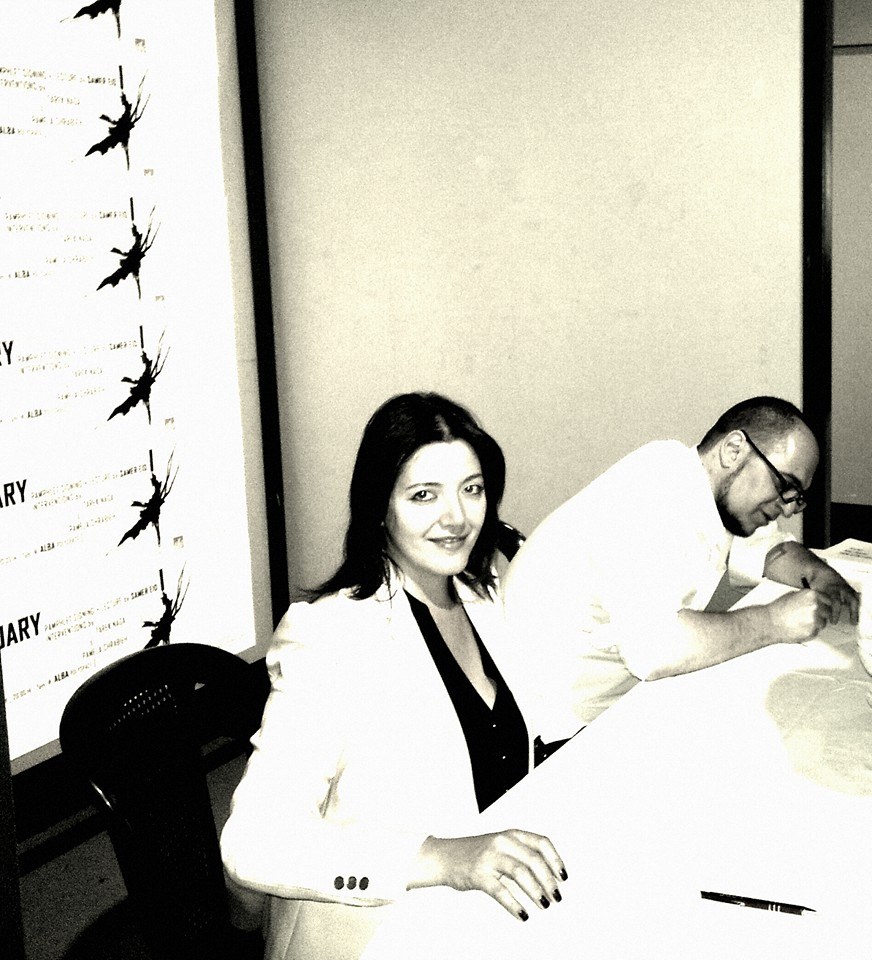
Dr. Pamela Chrabieh and Architect Samer Eid
MOR-TUARY Event and Project, ALBA,
Lebanon, 20-05-2014
Lebanon has witnessed several conflicts in the last decades, caught in a never-ending cycle of wars, both physical and psychological. One of the dramatic consequences was the proliferation of disparate scattered cities and neighborhoods run by warlords, mafia leaders and tribes, manipulated proxies who mastered the art of utilizing their people, and unconventional participants in warfare like suicide-bombers, guerrilla forces, private military contractors, reapers and other unmanned predator vehicles.
In ‘The Garden of the Prophet’ (1934), Gibran Khalil Gibran stated the following: “Pity the nation that welcomes its new ruler with trumpeting, and farewells him with hooting, only to welcome another with trumpeting again. Pity the nation whose sages are dumb with years and whose strong men are yet in the cradle. Pity the nation divided into fragments, each fragment deeming itself a nation”. Robert Fisk found this passage of Gibran contemporary enough to provide the title of his book, ‘Pity the Nation’ (1991), characterizing Lebanon as ‘agonizing’… Unfortunately, ‘agony’ isn’t the proper word which can describe the current situation: there is no nation to pity anymore!
Facing this chaotic war dominant and constantly mutating reality, where violence has become a mere publicity instrument rather than the axis of struggle, one may choose to wait for the unknown, observe endings while doing nothing, leave for foreign oasis, or wipe inner tears turned into wounds, immure in loss, wallow in dead civilizations and become one.
One may choose between absolute sorrow, sorrow with no despite and death.
One may put off all mental images of the resurrected Phoenix on the wall, and shift the battle to the next generations.
Ambient amnesia… And hypermnesia …
There is no national war memory in Lebanon, thus no common history, nor identity, but a myriad of individual/collective memories, histories and identities. There are no contemporary common commemorative spaces, no national martyrs to remember beside the First World War’s, no shared mourning gatherings, no official research centers, nor common political will to support critical discussions about the war, but too many sectarian commemorations. This problem is related to a state sponsored amnesia resulting partly from the general Amnesty Law of 1991 that coexists with the widely differing narratives of the war – political, sectarian, religious, non-religious, social, cultural, ethnic,…
Though many narratives are highly destructive, there are those which can be labeled as positive, contributing to peacebuilding. Artists, movie producers, architects, writers and activists in NGOs have become positive memory makers since the 1990s, shedding light on the war and its victims, depicting the horrors and the struggles to keep souls alive, stressing a causal link between remembrance and inter/trans-sectarian conviviality. Personal perceptions of the war have been depicted in fiction, diaries, music productions, paintings, architectural structures and novels by Lebanese from all backgrounds and identities, relating to all who are concerned with human survival, expressing particular types of memory based on contrition and solidarity facing war.
Most of these memory makers are more concerned with rethinking the past in order to build a better future than reducing their present to a quest of survival and thus shrinking the self to its minimal dimensions – living and operating self-criticism appears to be more important than being trapped in the victim state of mind. They create alternative localities (‘lieux alternatifs’) for a diversity of voices-paths to be communicated, expressed, debated and shared, thus promoting a unified yet pluralistic and mediated society. These localities reveal that social and political spaces are never structured neutrally like a ‘tabula rasa’, but instead consist of individual and collective discourses and practices, visions and interpretations of discursive forces.
Memory makers choose not to forget the past and grant blanket amnesties to the perpetrators of massive crimes. They choose to publicly expose the truth – their truths -, and bring solace to victims, such as in South Africa, Bosnia and Rwanda, where public acknowledgement of victims was considered to be the beginning of the healing process and a form of restorative versus punitive justice. They choose to erase urban borders, breach the divide among Lebanese whose memories linger in the betwixt space of sectarian/political violence, communal loyalty and the desire for a unified nation, and to transcend the contrast between public ruins such as the bullet-ridden Holiday Inn and the restored soulless downtown of Beirut.
Memory makers show that war victims are not only harmed physically (first death). The act of violence transmits an unambiguous message – that their views do not count and their voices will not be heard (second death). Therefore, their rebirth, their ascent from hell, becomes a must, at least through the rehabilitation of their forgotten voices and memories.
According to philosopher Paul Ricoeur in ‘The Memory of Suffering’ (1995), ‘we must remember because remembering is a moral duty. We owe a debt to the victims. And the tiniest way of paying our debt is to tell and retell what happened to them. We have learned from the Greek story-tellers and historians that the admirable deeds of the heroes needed to be remembered and thus called for narration. We learn from Jewish story-teller like Elie Wiesel that the horrible – the inverted image of the admirable – needs to be rescued still more from forgetfulness by the means of memory and narration’. In other words, the marginalized voices speak to the public ear, breaking the pyramid of hierarchy both in the living world and in the afterlife. The unspeakable and unthinkable are communicated and translated. The personal stories brought from the innermost of the individuals bind us anew to the collective.
War affected – and still is affecting – all Lebanese psychologically as individuals and in social/political relationships. It shaped – shapes – their beliefs and patterns of behavior. This contributes to the propensity to participate in the next wave of strife or pass it on to the next generation thereby fueling cycles of violence. Every Lebanese plays some role in this cycle, therefore bears responsibility in it.
The role and influence of events and beliefs from current and previous generations that perpetuate cycles and receptivity to hate is obvious to some, preposterous to others. Such thinking evolved early on in the field of psychology, as explained by Carl Jung in ‘Memories, Dreams, Reflections’ (1963): ‘I feel very strongly that I am under the influence of things or questions which were left incomplete and unanswered by my parents and grandparents and more distant ancestors . It often seems as if there was an impersonal karma within a family, which is passed on from parents to children. It has always seemed to me that I had to answer questions which fate had posed to my forefathers, and which had not yet been answered, or as if I had to complete, or perhaps continue, things which previous ages had left unfinished. It is difficult to determine whether these questions are more of a personal or more of a general (collective) nature. It seems to me that the latter is the case. A collective problem, if not recognized as such, always appears as a personal problem, and in individual cases may give the impression that something is out of order in the realm of the personal psyche. The personal sphere is indeed disturbed, but such disturbances need not be primary; they may well be secondary, the consequence of an insupportable change in the social atmosphere. The cause of disturbance is, therefore, not to be sought in the personal surroundings, but rather in the collective situation’.
There is indeed a role for ancestors and their deeds in the present lives of their descendants. In many cultures, ancestors are seen as available to guide, teach, and to nurture. They represent one of the pathways between the knowledge of this world and the next. Unless the relationship between the living and the dead is in balance, chaos results; and if the imbalance exists, the living individuals have the duty to heal their ancestors, to resolve ‘sick energies’.
According to psychotherapist and initiator of the Garden of Forgiveness in central Beirut, Alexandra Asseily, Lebanese have to become good ancestors, stop being ‘the prisoners and the puppets of the stinging memories of strife’, clean up ‘ancestral arteries so that children are free to act in the now, free from the blocks with echo from the past’, let history inform them, not control them (in ‘Breaking the Cycle of Violence in Lebanon- and Beyond’, 2007). Therefore, they must undergo a process that falls into three steps: take responsibility for the active or passive role they play in propagating war; create a space of self-reflection sot that they can become aware of nocuous behaviors and beliefs that reinforce that role; release the source of grievances they hold on to, so that they can be free to replace old habits and think with new life-affirming ones thereby creating positive cycles around them and their children.
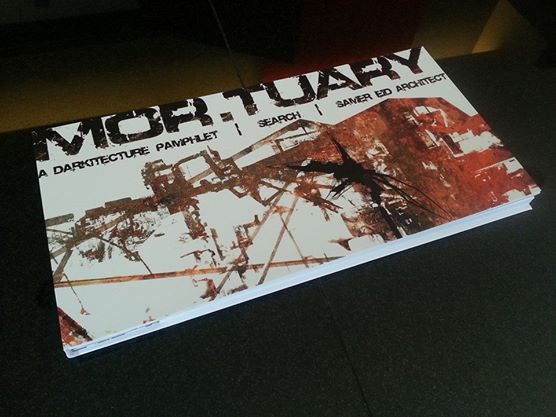
MOR.TUARY incarnates this quest to the past and its abysses, linking it to the present and future, a channel between the visible and the invisible, humanity and a transcendental power conducive to reconciliation. It offers a creative new momentum of transformation and healing, and reminds us all that horrors should never be forgotten in order not to occur again. They should not be forgotten so Lebanese will be able to address their cycles of fear, anger and guilt, to build effective bulwark against future human rights’ violations, and to recover the soul of their nation.

Dr. Pamela Chrabieh with Samer Eid, Alba, Lebanon, 2014
This article was published in Samer Eid’s Architecture Pamphlet MOR-TUARY, Beirut, Color Balance, 2013.

Samer Eid, MOR-TUARY, ALBA, Lebanon, May 2014
Forewords by Dr. Pamela Chrabieh and Architect Tarek Naga
Dr. Pamela Chrabieh
Dr. Pamela Chrabieh
in Samer Eid’s Architecture Pamphlet
Lebanon, 2013